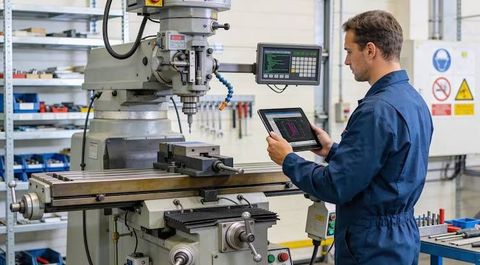
Automated CNC Milling Machine Suppliers: Insights Into Equipment Selection
Precision-machined components are essential across industries such as aerospace, automotive manufacturing, medical equipment, and industrial machinery.
Automated CNC milling machine suppliers support these operations by providing equipment that converts digital designs into accurately machined parts through computer-controlled cutting processes.
Selecting suitable CNC milling equipment involves more than comparing machine specifications. Manufacturers must consider component geometry, material properties, production volume, dimensional tolerances, automation requirements, and compatibility with existing manufacturing systems. The right configuration depends on how these factors interact within a specific production environment.
Understanding the equipment selection process helps manufacturing teams evaluate machine capabilities, supplier expertise, software integration, and long-term operational requirements. These considerations provide a practical foundation for choosing CNC milling equipment that supports consistent production and reliable machining performance.
How Automated CNC Milling Machines Work
Computer numerical control (CNC) milling uses programmed instructions to move cutting tools and workpieces along specified axes. The cutting tool removes material from a solid workpiece to create features such as slots, holes, pockets, contours, and flat surfaces.
Automation allows the machine to execute programmed operations with limited manual intervention. Depending on the configuration, automated functions may include tool changes, workpiece positioning, pallet exchange, probing, and in-process measurement.
A typical workflow begins with a computer-aided design (CAD) model. Manufacturing engineers use computer-aided manufacturing (CAM) software to generate toolpaths and machining instructions, which are then processed by the CNC control system.
The machine follows these instructions while controlling spindle rotation, axis movement, feed rates, and other machining parameters. Sensors, tool monitoring systems, and inspection routines can help identify deviations before they affect a larger production batch.
Matching Machine Configuration to Production Needs
Automated CNC milling machines are available in different configurations, and each arrangement supports particular manufacturing requirements. Equipment selection should begin with the components being produced rather than the number of features advertised by a supplier.
Three-axis milling machines move along the X, Y, and Z axes. They are suitable for many prismatic components, including plates, brackets, housings, and parts with features accessible from a limited number of directions.
Four-axis systems add a rotational axis, allowing workpieces to be indexed or positioned at different angles. This can reduce repeated setups when components require machining on multiple sides.
Five-axis machines provide additional rotational movement, enabling more complex surfaces and angled features to be machined with fewer repositioning operations. They are often considered for aerospace components, complex molds, and precision parts with demanding geometries.
The choice depends on part complexity, setup requirements, accuracy expectations, and production economics. A more complex machine is not automatically more productive if the work primarily involves straightforward operations.
Evaluating Spindle Performance and Machine Structure
Spindle performance directly affects cutting capability, surface finish, and machining efficiency. Important characteristics include spindle speed, available torque, power delivery, tool interface, and thermal stability.
High spindle speeds can support small cutting tools and certain finishing operations, while higher torque is valuable for demanding cuts in tougher materials. The appropriate balance depends on the workpiece material, cutter diameter, cutting strategy, and depth of cut.
Machine rigidity is equally significant. A rigid structure helps resist cutting forces and reduces unwanted vibration, which can affect dimensional accuracy and tool life. The base, column, guideways, spindle assembly, and axis-drive system all contribute to overall performance.
Thermal behavior also deserves attention. Heat generated during machining and changes in the surrounding environment can influence machine geometry. For applications with tight tolerances, manufacturers should examine thermal compensation features, warm-up procedures, and documented accuracy performance.
Automation Features That Influence Productivity
Automation can reduce manual handling, improve repeatability, and support more consistent machine utilization. However, the value of each feature depends on the production workflow.
An automatic tool changer allows the machine to switch between cutting tools during a programmed cycle. This supports multi-operation machining without requiring an operator to replace every tool manually.
Pallet changers allow one workpiece to be machined while another is prepared outside the cutting area. In suitable production environments, this can reduce idle time associated with loading and unloading.
Robotic loading systems can transfer parts between storage fixtures and the machine. These systems require careful integration with workholding, machine access, safety equipment, and production scheduling.
In-process probing can measure workpiece positions and selected features during machining. Tool-breakage detection and tool-life monitoring can also help identify problems before they create repeated defects.
When evaluating automation, manufacturers should distinguish between features that reduce genuine production constraints and features that add complexity without addressing an existing need.
Software, Controls, and Factory Integration
CNC equipment must work with the software and production systems used throughout the manufacturing operation. Compatibility influences programming, setup time, data exchange, and the ability to introduce future process improvements.
CAD and CAM systems define component geometry and generate machining toolpaths. The CNC controller interprets the resulting instructions and coordinates machine movement. Differences in control interfaces, programming conventions, and supported functions can affect how easily existing programs transfer to a new machine.
For connected manufacturing environments, communication with manufacturing execution systems (MES), production planning software, and machine-monitoring platforms may also matter. Data integration can help teams track machine status, cycle times, tool usage, and production interruptions.
Suppliers should clarify supported file formats, control-system capabilities, remote diagnostics, software licensing arrangements, and the availability of technical support. These details help prevent integration problems after equipment installation.
How to Evaluate Automated CNC Milling Machine Suppliers
Supplier evaluation should cover both the machine itself and the capabilities needed to operate it reliably. Technical specifications are useful, but they do not fully demonstrate how equipment will perform under actual production conditions.
A supplier should be able to explain the machine's working envelope, spindle characteristics, positioning specifications, tool capacity, control system, and supported automation options. These details should be assessed against representative components and realistic operating conditions.
Application engineering support is particularly valuable when machining unfamiliar materials or complex geometries. A supplier that understands workholding, cutting strategies, tooling, and process development can help identify potential limitations before production begins.
Other considerations include installation planning, operator training, maintenance documentation, spare-parts availability, warranty conditions, and response procedures for technical problems.
Where possible, manufacturers should request a machining demonstration using a representative component or comparable material. Evaluating the resulting part can provide insight into surface finish, dimensional consistency, cycle time, and practical machine accessibility.
Understanding Accuracy, Repeatability, and Quality Control
Accuracy and repeatability are related but different measures. Accuracy describes how closely a machine's actual performance matches a specified target, while repeatability concerns its ability to produce consistent results under comparable conditions.
A machine may repeatedly produce the same result without meeting the required nominal dimension. Conversely, a machine that performs well under one set of conditions may show variation when temperature, tooling, workholding, or operating procedures change.
Manufacturers should review the measurement methods and conditions behind supplier specifications. Positioning accuracy alone does not guarantee that every finished component will meet its drawing tolerances.
Workpiece inspection, tool calibration, fixture stability, cutting-parameter control, and environmental conditions all influence the final result. For demanding applications, these factors should be evaluated alongside the machine's documented performance.
Planning Maintenance and Long-Term Operation
CNC milling equipment relies on mechanical, electrical, lubrication, cooling, and control systems that require ongoing attention. Preventive maintenance helps reduce unexpected interruptions and supports stable machining performance.
Typical activities include checking lubrication systems, inspecting filters, maintaining coolant quality, cleaning chip-management equipment, checking toolholders, and following the manufacturer's procedures for spindle and axis maintenance.
Maintenance planning should also consider operator access to diagnostic information and the availability of replacement components. A machine with sophisticated automation may require additional training and technical support compared with a simpler configuration.
Before selecting equipment, production teams should establish how maintenance responsibilities will be divided between internal technicians and the supplier. Clear procedures can help reduce downtime and improve the consistency of machine operation.
Frequently Asked Questions
What should manufacturers consider first when selecting a CNC milling machine?
Start with component geometry, material, dimensional tolerances, production volume, and required cycle time. These factors determine the machine configuration, spindle capabilities, work envelope, tooling, and automation features needed.
Is a five-axis CNC milling machine necessary for every application?
No. Three-axis machines handle many conventional components effectively, while four-axis and five-axis configurations are useful when additional rotational movement reduces setups or enables complex machining operations.
Why is supplier technical support important?
Technical support can help with installation, programming, operator training, maintenance, troubleshooting, and process development. These capabilities influence how effectively the equipment performs after commissioning.
How can manufacturers evaluate machining quality before selecting equipment?
A representative machining trial can help assess dimensional accuracy, surface finish, repeatability, and cycle time. Results should be checked against the actual component drawing and inspection requirements.
Which automation features can reduce machine downtime?
Automatic tool changers, pallet systems, tool monitoring, probing, and robotic loading can reduce specific sources of interruption. Their usefulness depends on the production process, setup requirements, and existing bottlenecks.
Conclusion
Selecting automated CNC milling equipment requires a clear understanding of machining requirements, machine capabilities, automation needs, and supplier support. Spindle performance, structural rigidity, software compatibility, accuracy, and maintenance planning all contribute to reliable production.
A well-matched machine should satisfy current component requirements while supporting realistic production goals and future operational needs. By evaluating equipment through representative machining tasks and practical supplier discussions, manufacturers can make informed decisions based on measurable performance rather than specifications alone.

Related Post...
Die Casting Manufacturing Equipment: Explore Machines and Production Processes
Updated: October 02, 2026
Read More
Automated Optical Inspection Machines: Insights Into Automated Quality Control
Updated: October 02, 2026
Read More
Sheet Cutting Machines Explore How Industrial Cutting Methods Work
Updated: September 07, 2026
Read More